Restaurant Chatbot — WhatsApp & Instagram AI: The Fastest Way to Grow Orders, Reservations, and Customer Satisfaction
If you run a restaurant, you know this scene well: the evening rush has started, the kitchen is full, there's a line at the register — and right then, messages come in one after another on WhatsApp. "Are you open?", "Do you do takeout?", "Are there vegan options on the menu?", "Can you send your location?", "Can I reserve a table for two?"
No one is in a position to reply. The customer waits 3 minutes, waits 5 minutes, then messages another restaurant. The order is gone.
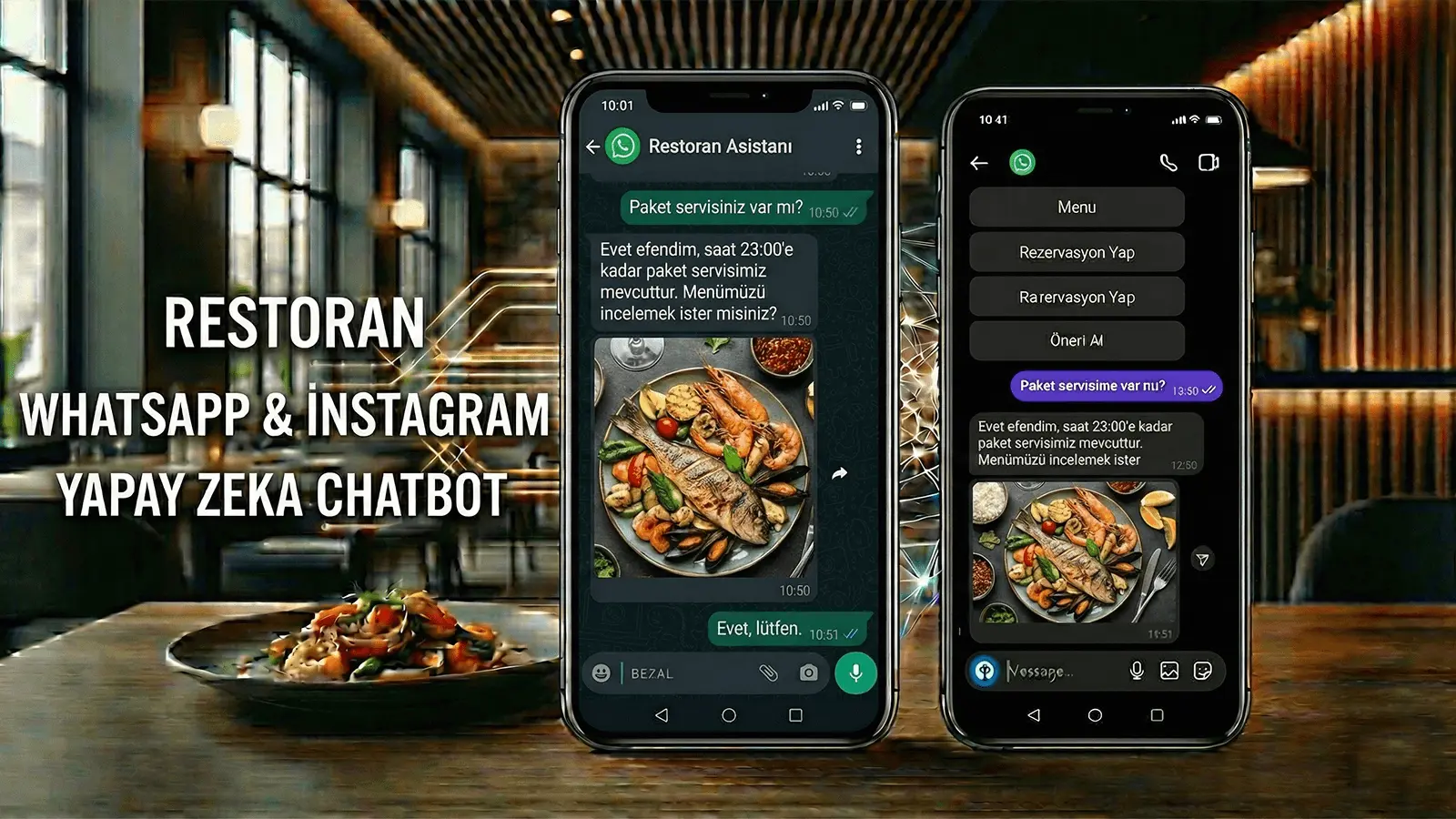
This is exactly what we mean by restaurant chatbot WhatsApp AI — it exists to save that very moment. A chatbot working over WhatsApp or Instagram DM greets the customer's message instantly, gives the right answer to their question, and starts the order or reservation flow when needed. The result is simple: faster replies, more orders, less phone traffic, happier customers.
In this article, we'll explain the concrete benefits of using a chatbot in restaurants, real-world scenarios, and how WhatsApp and Instagram work differently for a restaurant. We'll drop the theory and focus on practice.
7 Concrete Benefits of Using a Restaurant Chatbot
1) A hungry customer won't wait — so don't keep them waiting
This is the most basic truth. Ordering food isn't a "let me think about it" matter; it's an instant decision. The customer is hungry, opened their phone, and messaged you. If no reply comes in 3 minutes? They go to a competitor. The chatbot replies the moment a message arrives and doesn't miss that critical window.
Don't brush this off as just "speed." In a test we ran with a restaurant client, when the average response time dropped from 12 minutes to 8 seconds, the number of weekly orders coming via WhatsApp nearly doubled. In this business, speed really is everything.
2) The phone and cashier load drops significantly
In restaurants, the phones ring nonstop during lunch and dinner rush. Cashiers take payments, answer the phone, and check WhatsApp all at once. When the chatbot automatically answers repetitive questions like working hours, menu, location, and delivery zones, the team can focus on their actual work.
Think about it — what percentage of the messages that come in during the day are the same 5-6 questions? At most restaurants, this rate is over 70%. When the chatbot handles these questions, the cashier and waiter attend to the customer instead of the phone.
3) The reservation process gets organized
"Is there a table tonight?" is every restaurant's classic. But the real problem is this: the customer says "yes, is there?", you say "how many people?", the customer writes "2 people" 10 minutes later, you say "what time?", and they reply half an hour later… This exchange sometimes drags on for hours.
The chatbot collects this information in order and quickly: number of people, date, time, name, phone, special notes (like a high chair, birthday, allergy). It's much more comfortable for the customer too — everything's done in a minute.
4) It instantly resolves menu and allergen questions
"Is it spicy?", "Are there vegan options?", "What's gluten-free?", "I have a peanut allergy, which can I eat?" — these questions are both sensitive and need to be answered correctly. A waiter may give wrong information when busy, but when the correct menu information is loaded into the chatbot, the risk of error drops sharply.
What's more, getting fast and reliable answers to such questions builds serious trust in the customer. When trust is established, the order decision speeds up too — the two are directly connected.
5) Campaigns stop being "announcements" and turn into "orders"
Most restaurants do campaigns like this: prepare a visual, post a story, wait. The difference with a chatbot is this — after the customer sees the campaign message, you can put clear options in front of them: "Order now," "See the menu," "Get the location." In other words, the campaign turns from a visual into action.
When you publish campaigns like "menu of the week," "second drink half price," or "lunch menu 149 TL" via WhatsApp or Instagram DM with this flow, the order flow starts right after the announcement. This gives a far different conversion rate than posting a story and saying "those interested, message us."
6) It ends location confusion in multi-branch setups
If you have multiple branches, you know this well: the customer messages the wrong branch, the order goes to the wrong place, the address gets mixed up, the delivery zone doesn't match. In the first message, the chatbot asks for the customer's location or has them select a city/district, then routes them to the right branch.
This provides serious order especially for chain restaurants and franchise structures. When each branch's own menu, working hours, and delivery zone are defined in the chatbot, the customer is automatically connected to the right place.
7) Collecting feedback is no longer "extra work"
An automatic message after the order: "Did your order arrive? Is everything okay?" The customer leaves a short evaluation — if positive, they're thanked; if negative, they're immediately transferred to live support.
The critical thing here is this: a customer who had a bad experience usually leaves quietly and never comes back. But if you catch them in that moment and solve the problem, that customer can turn into a loyal one. The chatbot does this catching automatically — without you even noticing.
5 Real-World Scenarios
Let's drop the theory and look at the flows that work best in practice. These aren't hypothetical; they're scenarios we've tested and gotten results from with our restaurant clients.
Scenario 1: Quick takeout order via WhatsApp
The customer writes: "Hi, do you do takeout?"
The bot asks for the location and checks the delivery zone. If the zone is eligible, it presents the menu categories — burgers, pizza, döner, drinks. The customer makes their choice, the bot asks whether they'd like fries or a drink alongside (cross-selling kicks in here), then takes the address, name, and phone details.
The whole process is 2-3 minutes. The order is collected without the cashier being tied up. We call this the "silent order line" — the phone doesn't ring, but orders come in.
Scenario 2: An evening reservation via Instagram DM
The customer sees your story and messages via DM: "Is there a table tonight?"
The bot steps in right away — how many people, what time, name, phone. A special note if any: Is it a birthday, is a high chair needed, do they want a window seat? After all the information is collected, a confirmation message goes out.
The beauty of this flow: the warm interest coming from a story on Instagram turns into a concrete reservation within 1 minute. In the past, this interest often vanished with "I'll call later."
Scenario 3: Allergen and diet questions
"Do you have gluten-free options?" — this question seems simple, but there's a serious sensitivity behind it. Based on the menu information, the chatbot lists the gluten-free options, then asks whether there are any other allergies and adds the note to the order.
What matters here: the customer feels safe. And a customer who feels safe places an order.
Scenario 4: Managing expectations during rush hours
Friday evening, 8 p.m., the kitchen is full, delivery time has stretched. The chatbot knows this and tells the customer transparently: "We're at our busy hour right now, average delivery time is 45-55 minutes. Would you like to continue?"
This simple piece of information drops the complaint rate incredibly. When a customer waits while informed, "why hasn't it come yet?" messages decrease dramatically. Expectation management is the most underrated part of customer satisfaction.
Scenario 5: Post-order satisfaction + repeat order
An automatic message 30 minutes after the order is delivered: "Did your order arrive?" Then a short evaluation question. If the answer is positive: "Your 10% discount code valid on your next order: TEKRAR10." If negative, immediate transfer to live support.
The effect of this flow is two-way — you catch the negative experience instantly, and you encourage the satisfied customer toward a repeat order. A single automatic message does two different jobs at once.
WhatsApp or Instagram? Which One for a Restaurant?
We get this question a lot, and our answer is always the same: both, but for different jobs.
WhatsApp is very strong on the order and reservation side. The customer is already writing with the intent to "buy." The communication is more direct, and the conversion rate is higher. Takeout orders, table booking, sharing a location — these all flow very naturally on WhatsApp.
Instagram, on the other hand, is the channel for acquiring new customers. You post Reels, you post stories, and someone says "ooh this looks good" and writes via DM. Catching that curiosity and turning it into an order is Instagram's job.
In practice, the model that works best is hybrid: draw interest on Instagram, start the conversation in the DM, then route to WhatsApp and close the order. Restaurants that do this get maximum value from both channels.
The Mettanex Restaurant Chatbot Approach
Many companies say "we make chatbots." But the restaurant sector is a world of its own — there's the concept of rush hours, the menu changes constantly, delivery zones differ, and cross-branch consistency is critical. A general-purpose chatbot can't capture these details.
In the system we set up for restaurants, the following come as standard:
Order, reservation, and menu flows are set up ready on WhatsApp and Instagram. If you have a multi-branch setup, the customer is automatically routed to the right branch. During rush hours, delivery expectation management kicks in — transparent information is given to the customer. Post-order satisfaction tracking and catching negative experiences run automatically. Campaigns turn from mere announcements into conversion campaigns with an order flow behind them.
Our goal isn't to set up a "message-answering bot." It's to set up a system that grows the restaurant's order volume, reduces the team's load, and increases customer satisfaction in a measurable way.
We go live in 3 days — day one: menu, location, and working hours; day two: the reservation flow; day three: the WhatsApp order flow. We work by adding on top of the restaurant's existing workflow without disrupting it.
Frequently Asked Questions
Does restaurant chatbot WhatsApp AI really increase orders?
It does, and it makes the biggest impact through "speed." When the customer gets an answer the moment they ask, the order decision closes right there. A delayed reply usually means a lost order. This difference is very pronounced especially on the takeout side.
What happens if the chatbot misunderstands?
In menu-based flows (proceeding by offering options), the risk of error is already very low. In AI-powered free-text scenarios, we always add a "live support" exit. So if the chatbot gets stuck, the customer isn't left hanging — they're immediately connected to a person.
Do I need to hire extra staff for the setup?
Quite the opposite — the chatbot is set up precisely to reduce the existing team's load. The only thing you need to do is make short updates for menu or campaign changes. If you like, we can manage that too, and you won't have to touch anything.
Does it make sense for small restaurants too?
Absolutely. In fact, the impact is seen faster in small restaurants because the team is already small. One person is in the kitchen, at the register, and on the phone — the chatbot takes the phone and message load off that one person.