The Benefits of an Instagram DM AI Chatbot for E-Commerce Brands
Instagram is no longer just a platform for sharing photos. Especially for e-commerce brands, it has turned into a genuine sales channel. Customers see a product, like it, and immediately ask their questions via DM. In clothing stores, questions like "Does this run small?", "Will the M fit me?", and "Is it in stock?" come in, while cosmetics brands get flooded with messages like "Is it suitable for my dry skin?", "Which shade do you recommend?", and "Does it contain parabens?"
Do you know what these questions have in common? They all get repeated many times throughout the day. And behind each one is a potential sale.
This is exactly where an Instagram DM AI chatbot comes in. An AI-powered chatbot understands incoming messages, gives the right answer, and brings the customer closer to buying. What's more, it does this day and night, managing hundreds of conversations at the same time.
But does this system really work? Let's go through the concrete benefits e-commerce brands can gain from using an Instagram DM AI chatbot, one by one.
Fast Replies Mean More Sales
The biggest cause of lost sales in DMs is a late reply. The customer asks a question, no answer comes, and a few hours later they buy the same product from another page. Maybe your product was better, maybe your price was lower — but it doesn't matter; you lost that sale because you didn't reply.
An Instagram DM AI chatbot eliminates this problem. Whether it's midnight or a Sunday, it replies the moment a message arrives. This speed moves the customer from "just curious" to "ready to buy."
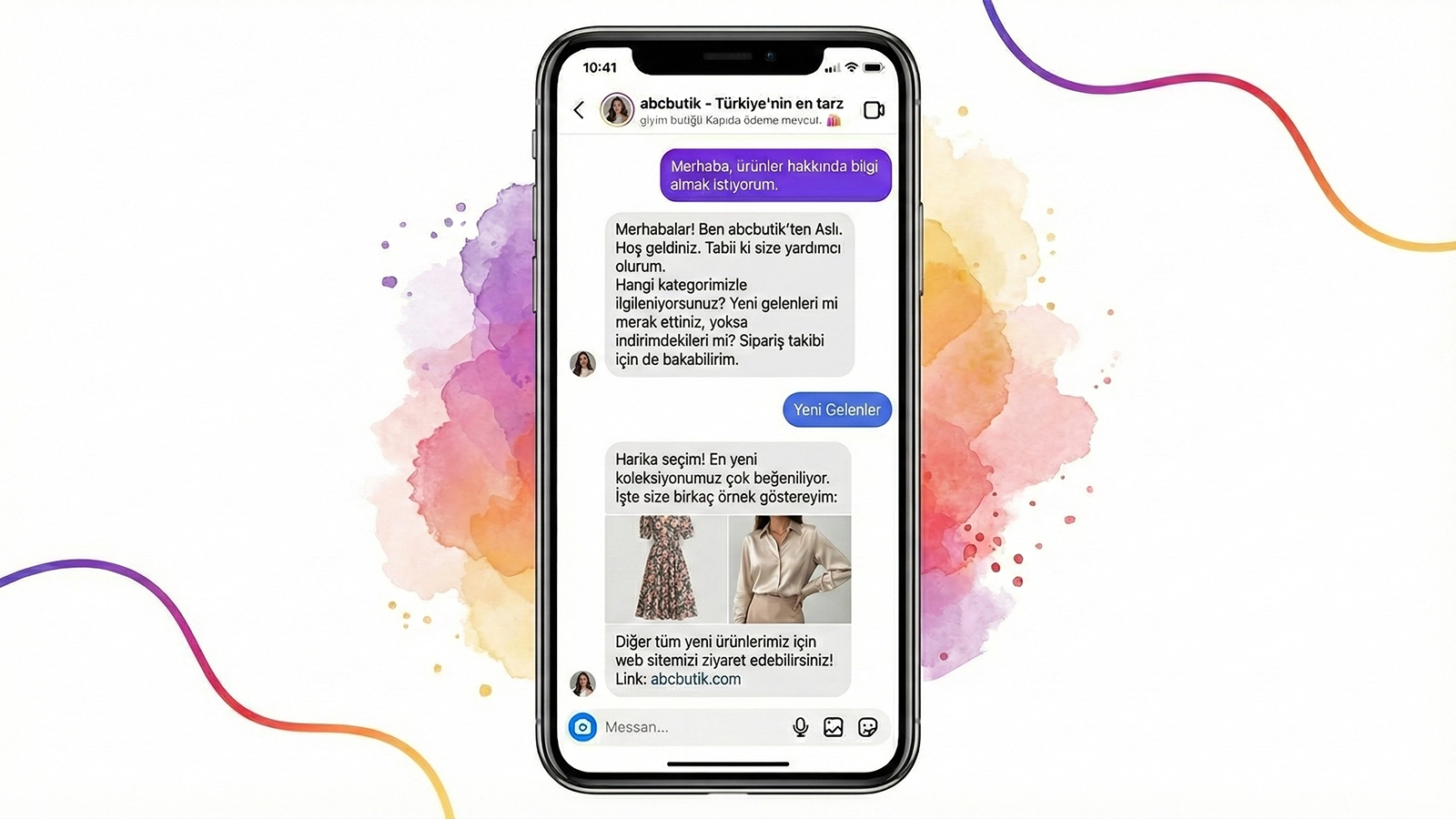
Imagine a clothing store. The customer asks, "Do you have an M? Does it run small?" The chatbot replies instantly: "The M is in stock. The product is true to size — you can take your normal size. If you like, share your height and weight and I'll give you a more precise recommendation." This conversation continues and most likely ends in a sale.
It's similar on the cosmetics side. To a customer who says, "I have dry skin, which moisturizer do you recommend?", the chatbot can reply: "We have products that provide intense moisture for dry skin. Our lines containing hyaluronic acid and ceramide are very suitable for this need. Do you have any sensitivity in your skin as well?" When the conversation flows like this, the customer feels like they're talking to a consultant in a store.
Repetitive Questions No Longer Tire Your Team
If you do e-commerce, you know what your DM inbox looks like. The vast majority of messages revolve around the same topics: stock status, size recommendations, shipping time, return conditions, campaign details… Answering these dozens of times a day takes time and becomes monotonous.
When the chatbot takes on this load, your team can breathe. Now, instead of everyone answering the same questions, they can focus on work that truly requires attention. More time remains for special requests, VIP customers, and problem resolution.
The most commonly automated topics are usually these: size and fit recommendations, color or shade selection, shipping time and tracking information, return and exchange conditions, store addresses and working hours, and active campaign and coupon information. A chatbot can easily handle all of these.
Personalized Recommendations Grow the Cart
The best part of AI is that it doesn't have to give every customer the same canned answer. The chatbot can understand what the customer wants and offer them tailored recommendations. This means a big opportunity for cross-selling and upselling.
Consider this scenario in a clothing store. The customer asks about size, the chatbot takes their height and weight, and learns whether they prefer oversize or a slim fit. Then it lists suitable products and suggests a combination: "This shirt is very popular, and these trousers would go great with it." The customer came to buy one product and leaves with two.
A similar flow can be built on the cosmetics side. The chatbot first asks about skin type, then learns whether there's any sensitivity, and then understands the expectation. Is the concern acne, blemishes, or dryness? After learning these, it recommends not a single product but a set: cleanser, serum, and moisturizer. On top of that, it notes, "If you'll use it during the day, I'd also recommend adding our product with SPF."
This way, the DM conversation stops being a simple Q&A and turns into real sales consulting.
It Builds Trust in Post-Sale Processes
In e-commerce, managing the post-sale stage is as important as making the sale. Providing fast, clear information on topics like shipping delays, the return process, and exchange procedures directly affects customer satisfaction. Hiccups in these areas can lead to negative reviews and customer loss.
The chatbot can manage these processes easily too. To a customer who says "Where is my package?", it instantly sends the tracking link or the courier's contact information. To the question "How do I return?", it shares a step-by-step explanation, the timeframe, and the conditions. To a customer who asks "Can I make an exchange?", it asks the eligibility questions and sends a request-form link.
This kind of fast, clear answer builds trust. Even a customer who wants to make a return doesn't lose faith in the brand when the process is easy, and the chance that they'll shop with you again increases.
It Handles the Rush During Campaign Periods
Black Friday, New Year's discounts, end-of-season sales… During these periods, the number of DMs multiplies. If you normally get fifty messages a day, that number can rise to two hundred during a campaign. Keeping up with that by manpower alone is nearly impossible.
An Instagram DM AI chatbot can scale to this volume. It can manage hundreds of conversations at once, deliver campaign messages correctly, and guide customers toward purchase. And it does so without tiring, without making mistakes, and serving every customer with the same quality.
Brands that work without a chatbot during these periods either have to temporarily increase their team size or experience serious delays in response times. In both cases, costs go up or sales are lost.
It Doesn't Make You Lose the Human Touch
Using a chatbot doesn't mean "humans will no longer talk to customers." The best systems work in a hybrid way: the chatbot handles the first contact, answers simple questions, and does the routing. But when a critical point is reached, it transfers the conversation to a live agent.
In which situations should it hand off? When there's a payment problem, when a special discount is requested, when a return is rejected, or when a product arrives damaged, the chatbot should leave the conversation to a human. Customers with high cart potential — that is, those asking about multiple products — can also be routed to an agent. On the cosmetics side, special situations like sensitive skin or allergies may also require human intervention.
This way, speed and quality come together. Simple questions are answered instantly, while critical matters are resolved in expert hands.
It Collects Valuable Data for Marketing
DM conversations are actually like free market research. Customers tell you exactly what they want, what they like, and why they didn't buy. By analyzing these conversations, a chatbot can extract valuable insights.
Which products are asked about most? Which size or color sees more demand? What are the most common problems with shipping or returns? Which campaign drew more interest? The answers to these questions can influence many decisions, from inventory planning to advertising strategy.
For example, if you look at the chatbot data and see that questions about M and L sizes far outnumber those about S, you can adjust your stock distribution accordingly. Or if a certain product constantly gets the question "When will shipping arrive?", you can add the estimated delivery time to that product's description.
What to Watch For Regarding Personal Data
When using a chatbot, you mustn't overlook data security. The basic principle is transparency and consent. It's important to tell the customer they're getting an automated reply, to offer the option to talk to a real person whenever they want, and to keep personal data to a minimum.
If information like a phone number or email address is going to be requested, it should be clear why it's needed. A clear explanation should be given, like "We need your phone number to keep you informed about your order." The collected data must be stored securely and used only for the stated purpose.
A Practical Way to Turn DMs into Sales
If you run an e-commerce business like a clothing store, boutique, or cosmetics brand, your Instagram DM traffic is genuinely valuable. Every incoming message carries a potential sales opportunity. But to capitalize on these opportunities, you need to be fast, provide accurate information, and guide the customer.
An Instagram DM AI chatbot does exactly that. It replies quickly, recommends the right product, manages post-sale processes, and hands off to a human at critical moments. As a result, your DM traffic turns into real sales.
At Mettanex, we build chatbot flows tailored to your brand. We can design core scenarios together — a size and fit recommendation flow, a shipping-returns-exchanges flow, a campaign and coupon flow, and rules for handing off to a live agent.
Frequently Asked Questions
What is an Instagram DM AI chatbot?
An Instagram DM AI chatbot is a system that automatically understands and replies to messages coming into your account. Unlike simple rule-based bots, AI-powered chatbots understand the content and intent of a message, giving more natural and personalized answers.
Can a chatbot replace a real person?
No, the best systems work in a hybrid way. The chatbot answers simple and repetitive questions and transfers the conversation to a live agent in complex or sensitive situations. This provides both speed and quality.
Does using a chatbot for e-commerce increase sales?
Yes. Fast replies reduce customer loss, personalized recommendations grow the cart, and 24/7 service means no sales opportunities are missed. It also makes managing the rush during campaign periods easier.
Which questions can the chatbot answer?
A chatbot can easily answer all frequently asked questions, such as stock status, size recommendations, shipping tracking, return conditions, campaign information, and working hours. AI-powered systems can also understand and answer more complex questions.
Does using a chatbot cause issues under data protection law (GDPR/KVKK)?
When set up correctly, it doesn't. The basic rules are telling the customer they're getting an automated reply, stating the purpose when collecting personal data, and storing data securely. When these rules are followed, chatbot use can be conducted in compliance with data protection law.