
Automatic Instagram Story Posting: A Story-Planning Guide with Mettanex
Let's admit something: while we were building Mettanex, the sentence we heard most was "We didn't post a story this week either." Beauty centers, clinics, multi-branch brands… They all fall into the same trap. There's a content idea — sometimes even the design is ready — but the day ends and no one posts. Then Monday comes and everyone says, "this week we'll be consistent." We aren't.
This is exactly what we mean by automatic Instagram story posting — it exists to break that very cycle. But let's say it right away: this isn't just a "scheduler button." Done right, it's an approach that completely changes your content production, your team coordination, and your campaign timing.
In this article, we'll explain the story-planning process through the Mettanex Platform. Rather than technical details, let's talk about what actually works in practice and what doesn't.
What Do We Mean by Story Automation?
It's actually very simple. You prepare your stories in advance, decide which day and time they'll go out, and the system handles the rest. But the real point is this: when you do this, "posting stories" stops being a chore and turns into a planned process.
The people who feel this most are: those who don't have time during the day to pick up their phone and prepare a story. Those who need to announce a campaign at 8 p.m. but are busy with a customer at 8. Or those who manage the Instagram of 4-5 different branches and try to look consistent across all of them.
Honestly, it's also a lifesaver for those who have a consistency goal but can never quite sustain it.
How Do Things Work in Mettanex?
The logic is this: prepare the content in advance, put it on the calendar, control the publishing flow. We know it sounds ordinary — but what breaks the ordinariness is in the details.
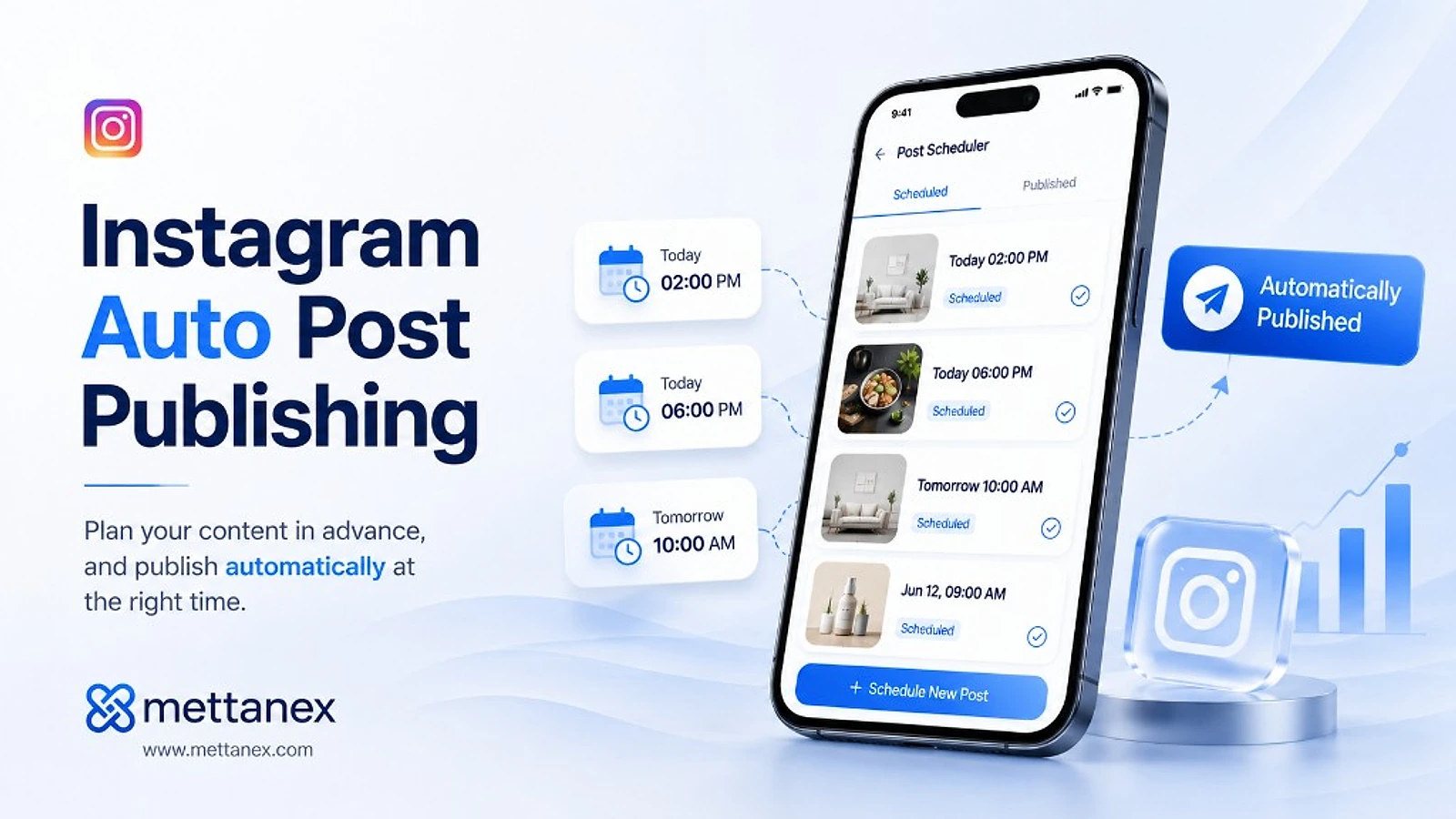
With the content calendar, you see your weekly or monthly plan on a single screen. This seems like a tiny thing but its impact is huge. Because the question "what will we post tomorrow?" disappears. In its place comes "is this week's content ready?" The difference is big.
The template logic is our favorite part too. Say you post a campaign story every Friday. Instead of designing from scratch each time, you create a template — you just update the text and image. This saves an incredible amount of time, especially in multi-branch brands.
Then there's the team workflow, which seems like a small detail but prevents chaos. Who prepares the content, who reviews it, who publishes it — once these are clear, the "I thought I'd posted it" conversation ends.
Step by Step: How to Plan a Story
Now let's get to the practical side. The names on the platform screens may be slightly different for you, but the flow is the same.
First, clarify the goal. Let each story have a single job. Is it to get appointments, pull people into DMs, or announce a campaign? Once the goal is clear, both design and copy come together in 5 minutes. If the goal is vague, you'll spend 45 minutes and the result will be vague too.
The format matter. Vertical 9:16 — everyone knows that, but there are people who don't know this: don't pile too much above and below the text. The Instagram interface covers those areas. Just have a clear, readable message in the middle of the story.
Creating a story in Mettanex is standard: upload the image or video, add the text field, set the CTA. By CTA we mean clear directions like "Send a DM," "Message us on WhatsApp," "Book an appointment." Please don't write "details in bio" — no one goes to the bio.
Time selection — this is critical. Don't assign random times. To start, test these ranges: weekdays between noon 12-2 p.m. and evening 7:30-10:30 p.m. Weekends between 1-4 p.m. and 8-11 p.m. Then you adjust based on your own data, but as a starting point these work.
The final check. After scheduling, always go over it. Are there typos, is the logo correct in the image, is the campaign date consistent? This 2-minute check sometimes prevents big embarrassments. Last month one of our clients was about to post a story that said "September campaign" in October — we caught it in the final check.
The 7 Mistakes Everyone Makes
When we observe those who set up story automation and still get no results, we see they get stuck on the same things.
First, trying to tell everything in every story. In one story, you explain the campaign, give the price, write the branch address, and also say "send a DM." It doesn't work. One story, one message.
Second, making the design cluttered. This is very common among beauty-center owners — the reflex to decorate everything, make it shiny, add effects. An Instagram story isn't a poster; it needs to be understood in 3 seconds.
Third, leaving the CTA vague. What does "contact us for information" mean? Where should I go? DM, phone, WhatsApp? Say it clearly.
Fourth, posting in a different tone every day. Monday very formal, Tuesday very casual, Wednesday completely incoherent. When the brand voice is lost, the follower is lost too.
Fifth, choosing times without a plan. Posting a story at 7 a.m. and saying "why doesn't anyone see it?" Your audience is beauty-center customers — they're not on Instagram at 7 a.m.
Sixth, posting a single story and leaving. Posting a single frame and saying "we posted today too" isn't enough. Mini series of 2-3 stories perform much better.
Seventh, and perhaps most important: not measuring. Saying "automation doesn't work" without looking at which story landed, which didn't, and where people tapped is taking the easy way out.
Mettanex's calendar and template structure already prevents most of these mistakes from the start, but it still pays to be deliberate.
A Ready-Made 7-Day Story Plan
Thinking "what should I post today?" every day is exhausting. Instead, settle on a pattern and drop your weekly content production to half an hour.
Our suggestion:
Monday: Weekly schedule or announcement. An opener like "What's happening at our branches this week?"
Tuesday: A short, clear answer to a frequently asked question. Like "How many sessions does laser hair removal take?" Both informative and trust-building.
Wednesday: A results image, a customer review, or a mini proof point. The "before-after" format is still the most engaging.
Thursday: A single tip or piece of information. Like "The most common mistake in skincare." Educational but brief.
Friday: A campaign or appointment call. People make their plans toward the weekend — like "Last 3 appointments for Saturday."
Saturday: A short behind-the-scenes video. Warm, unadorned, real. People want to see the place and the team.
Sunday: A poll or question box. Like "Which service would you like to try?" Both engagement increases and customer preferences are learned.
When you templatize this plan in Mettanex, all that's left each week is updating the text and images. 30-40 minutes, really.
Multi-Branch Management: Here, Automation Isn't a Luxury but a Necessity
If you manage a single branch, you might say "I already post stories anyway." But what if you have 3, 5, 10 branches? In Istanbul one branch's story is professional, in Ankara it's amateur, in Antalya there's no sound at all — this situation kills brand perception.
The model that works for our clients is this: the central team produces the templates and the campaign language. Branch teams make local adaptations — for example, an image specific to their city, their own working hours, their own branch address. Through the calendar, everyone moves to the same rhythm.
As a result, 5 branches' stories go out on the same day, all at the same quality and in the same brand voice — but each with its own local touch. This balance seems hard to maintain, but with the template system it's actually quite easy.
Frequently Asked Questions
Does this kind of automation put account security at risk?
The foundation of safe use is official API integrations and proper authorization. That's our approach at Mettanex too — we work not with suspicious third-party tools but with Meta's own permission structure. So there's no situation that puts account security at risk.
Does scheduled posting lower engagement?
We get this question a lot, and the answer is clear: no. What lowers engagement isn't planning but bad content and poor timing. In fact, because planned content brings order, organic reach even increases on most accounts.
Is it mandatory to post a story every day?
It's not mandatory, but being regular is. Even if it's 3 days a week, if you post in the same format on the same days every week, the Instagram algorithm evaluates you as a more consistent account. Consistency > frequency.
Final Word
If you're tired of hearing "we didn't post a story today either," the problem isn't you or your team — it's the system. As long as you see story posting as an "in-the-moment task," you can't get out of this cycle.
When you connect the automatic Instagram story posting process to a platform, both content production and campaign timing become predictable. And predictability is nothing to underestimate in marketing.
With the Mettanex Platform, it's possible to take story management out of "daily rush" and turn it into a "weekly routine." Try it, and you'll see the difference in the first week.